

What is Scoliosis in Children? Symptoms, Causes and Methods of Diagnosis
If you suspect that your child has a curvature in his spine or you have just received this diagnosis, you probably have many question marks in your mind...


Publication Date:
10/12/2025 2:47 PM
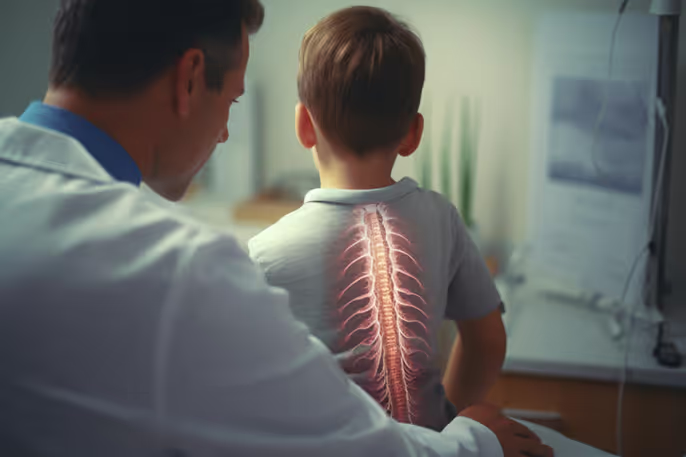
What is Scoliosis in Children? Symptoms, Causes and Methods of Diagnosis
If you suspect that your child has a curvature in his spine or you have just received this diagnosis, you probably have many question marks in your mind. In this article, scoliosis in children We address those who are curious about it in simple and straightforward language. Our goal is to keep you informed and help you take the right steps in this process.
What Is Scoliosis Simply?
Scoliosisis a medical term used for abnormal curvature of the spine over 10 degrees to the right or left. This condition can be observed in conjunction with the rotation (rotation) of the bones (vertebrae) that make up the spine in one direction. Scoliosis is not only bending to one side, but a three-dimensional deformity. Most often in children in adolescence occurs or progresses during a growth attack.
What are the Common Symptoms of Scoliosis in Children?
Scoliosis usually does not cause pain, so you can notice the symptoms through changes in physical appearance. Parents need to pay attention tothe following signs:
- Shoulder Asymmetry: One shoulder appears higher than the other.
- Scapillary Protrusion: One scapula is more prominent or elevated than the other.
- Hip Asymmetry: One hip may appear to be standing higher or more forward than the other.
- Body Imbalance: When the child leans forward (Adams forward bending test), a pronounced protrusion (rib hump) is formed on one side of the back relative to the other side.
- Distance Between Arms and Body: When standing upright, the space between the arms and the body on both sidesmay not appear equal.
- Clothing Failure to Fit Properly: Clothes, especially skirts or trouser legs, may appear longer on one side.
What Causes Scoliosis in Children What Are the Types of Scoliosis?
There are different types of scoliosis, and the causes vary depending on this type:
- Idiopathic Scoliosis (Cause Unknown): It is the most common form (80-85%). Although the exact cause is unknown, genetic predisposition is thought to play a role. In itself, it is classified by age:
- Infantile Idiopathic Scoliosis: 0-3 years
- Juvenile Idiopathic Scoliosis: 4-10 years
- Adolescent Idiopathic Scoliosis: 11-18 years old (most common type)
- Congenital (Congenital) Scoliosis: It is caused by an abnormality in the spine during development in the womb. Conditions such as the absence of complete formation of the vertebrae or their adhesion to each other cause this type.
- Neuromuscular Scoliosis: It develops due to underlying neurological or muscular diseases (for example, cerebral palsy, muscular dystrophy, spina bifida). It usually tends to progress faster and is more likely to require surgical intervention.
- Syndromic Scoliosis: Marfan syndrome occurs in association with certain syndromes, such as neurofibromatosis.
How to Diagnose Scoliosis?
The diagnostic process is usually a physical examination It starts with. Your doctor will examine your child in detail, including a leaning forward test. In case of doubt, to determine the exact diagnosis and measure the degree of curvature radiological imaging It is desirable:
- X-ray (Scoliosis Graph): The location, shape of the curvature, and Cobb angle The name is the gold standard method for measuring the degree of precision.
- Magnetic Resonance Imaging (MRI): It is used to rule out underlying spinal cord problems (for example, nerve ligament - tethered cord, syrinx), especially in children at an early age, in infantile and juvenile scoliosis or in the presence of a neurological finding.
Do Scoliosis Progresses? How to Follow Up
Adolescent idiopathic scoliosisis at risk of progression as long as the child's growth potential continues. The period of puberty, when growth is the fastest, is the risky period for progression. The higher the curvature and the more growth potential the child has, the greater the risk of progression. Your post-diagnosis physician will be regular based on the degree of curvature and your child's growth potential tailing will suggest. These follow-ups are usually done at intervals of 4-6 months and control x-rays are taken to see if there is progress.
Don't forget: Early diagnosis is the most critical step in the management of scoliosis. Regular pediatric check-ups and parents' caution to the above symptoms greatly increase the chances of an early diagnosis.
Important Notice: This content is for informational purposes only, and can never replace a doctor's examination and recommendations. If you suspect or have been diagnosed with scoliosis in your child, for diagnosis, follow-up and treatment options please contact a children's orthopedist. Each child's situation is unique and the most appropriate training plan will be determined by your doctor's detailed evaluation.
FAQS
We have put together frequently asked questions so that we can help you better. You can easily find the information you are looking for below
Do you still have something on your mind?
We're here! You can contact us to help you as soon as possible.